 Click to enlarge
ZigbeX Wireless Sensor Network KE10080
Ask About This ProductDescription
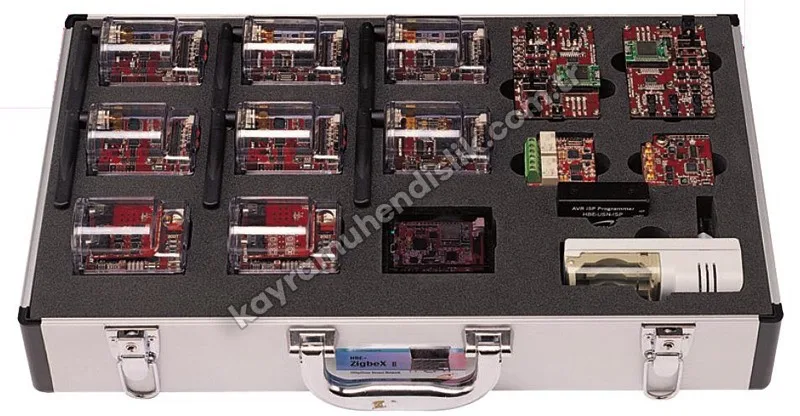
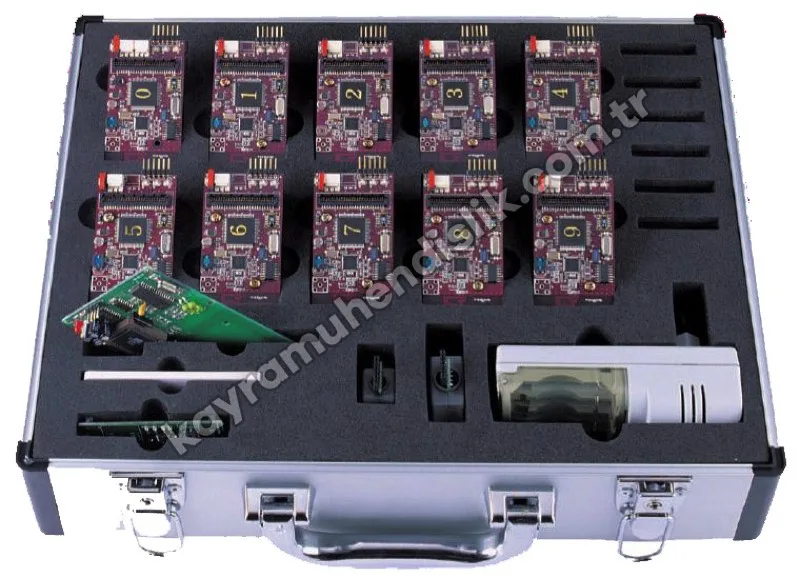
IntroductionAdvances in microelectronics and communication systems have made sensing and communication devices smaller and cheaper. These devices are placed in a physical environment and collect physical information. These smart sensors form a wireless sensor network that transmits data received over multiple hops to the information-gathering node (sink node). Because this network can sense the environment and human activity, it is regarded as one of the key technologies applied in ubiquitous systems. As a result, thanks to the latest research on wireless sensor network technologies at universities and research centres, there has been great demand for efficient sensor test environments. ZigbeX has been developed in line with this trend and offers solutions for education, research and performance evaluation of wireless sensor networks. In addition, various optional sensors and enhanced server platforms (used as the sink node) make ZigbeX a smarter, more flexible device. With many different examples included in the platform, users can easily learn about wireless sensor networks, MAC, embedded systems and sensing control mechanisms.
General features
| General-purpose ATmega128L CPU | Basic sensors |
| Balanced 8-bit high-performance platform | Temperature, humidity and light sensors |
| PCB pattern antenna and extended antenna port | Optional sensors |
| Size: 40 x 70 mm | Weather sensor module: temperature, humidity, light, acceleration, atmospheric pressure |
| 1.2 V rechargeable battery (2) | Location module: GPS |
| TinyOS support | Home module: motion detector, reed switch |
| Ad-hoc network support | Bio sensor module: body temperature and pulse measurement |
| IEEE 802.15.4 PHY/MAC support | Ultrasonic module: indoor positioning |
| External antenna port support to increase communication range | Relay module: relay switch control |
| Support for many sensors (temperature, humidity, light) | USB module: USB interface |
| Support for many training programs | Bluetooth module: Bluetooth communication support |
| User manual | Motor control module: motor control |
| Development tools | LCD module: support for writing on an LCD |
| AC input circuit board: AC relay switch control |
Optional sensor modules
| 1. Motor control module | 15. Blood pressure module |
| 2. Ultrasonic module | 16. SpO2 module |
| 3. Home module | 17. 3-axis acceleration sensor module |
| 4. AC input module | 18. CO2 sensor module |
| 5. Bio sensor module | 19. Compass module |
| 6. Weather sensor module | 20. Image module |
| 7. Location module | 21. Dust module |
| 8. USB module | 22. CO module |
| 9. LCD module | 23. Ozone module |
| 10. Bluetooth module | 24. NO module |
| 11. Relay module | 25. VOC module |
| 12. USB ISP module | 26. TN9 module |
| 13. IR remote control module | 27. RFID module |
| 14. DIO module |
Training topics
| Theory | 1. Introduction to USN |
| Theory | 2. An overview of ZigbeX |
| Theory | 3. Setting up and downloading the development environment |
| Theory | 4. TinyOS and NesC |
| Theory | 5. Java application drivers |
| Experiments | 1. LED control using tasks |
| Experiments | 2. LED control using a timer |
| Experiments | 3. HelloWorld example using LEDs |
| Experiments | 4. Light sensor control |
| Experiments | 5. Temperature/humidity sensor control |
| Experiments | 6. Infrared sensor control |
| Experiments | 7. EEPROM control using interrupts |
| Experiments | 8. Reading the serial ID |
| Experiments | 9. Serial connection with a PC |
| Experiments | 10. Basic wireless MAC protocol (MAC I) |
| Experiments | 11. Energy-saving MAC protocol (MAC II) |
| Experiments | 12. RF power control and multichannel |
| Experiments | 13. Wireless ad-hoc network using TOSSIM |
| Experiments | 14. USN network application protocol |
| Experiments | 15. Multi-hop example using tree routing (all sensors) |
Delivery and Installation
Before shipment, our products are inspected and packed in special impact-resistant packaging, and are delivered safely to every province of Türkiye.
Installation: In laboratory and classroom projects, installation and commissioning after delivery are carried out by our expert team.
Training and support: User training and after-sales technical support are provided for experiment sets and simulators.