 Click to enlarge
Solar Cell Experiments KED4402
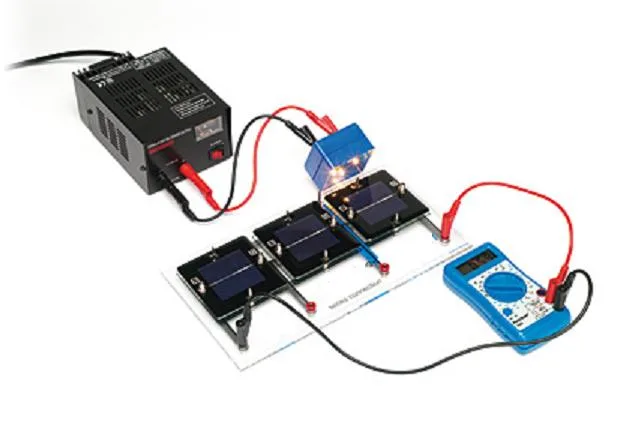
Efficiency calculation with a movable light source and solar cells connected in series or parallel, by measuring short-circuit current and open-circuit voltage
Description
Experiments that can be carried out:
- Series-parallel connection,
- Variation of I and V with source distance,
- Variation of I and V with ambient temperature,
- Changing the source spectrum with filters,
- Solar cell efficiency calculations,
- Solar cell + lithium battery charge-discharge experiments
Standard Materials
6 solar cells, 1 voltmeters, 1 ammeters, 1 10 mW/cm2 light source, connection accessories and cables, 1 rechargeable Li or Ni-Cd battery, 1 thermometer
Notes
This experiment set teaches what to pay attention to when generating electricity from the sun. A halogen lamp with an intensity of 10 mW/cm2 is used as the light source. All the characteristic properties of solar cells are also studied, and experiments such as connecting lithium batteries and charging and discharging them can be carried out. Addressing alternative energy, a subject of great importance today, this experiment set will enrich your laboratory.
For the current-voltage characteristic in these experiments, the circuit shown alongside is used. The variable resistor connected to the circuit limits the current produced by the solar cell. Voltages and currents are measured by changing R. The current measured at R=0 is the short-circuit current, and the voltage measured at the maximum value of R is the open-circuit voltage. The current-voltage graph is shown alongside. When the necessary analysis is made using the solar cell diode model, it can be found from the graph, for example, that I=0.43[1- e13/84V]+ 250 mA. From this equation, the voltage at maximum power (P=IV), Vmg can be found. This experiment set also studies how the voltages vary with ambient temperature, distance and angle of incidence, and efficiency calculations are made.
Delivery and Installation
Before shipment, our products are inspected and packed in special impact-resistant packaging, and are delivered safely to every province of Türkiye.
Installation: In laboratory and classroom projects, installation and commissioning after delivery are carried out by our expert team.
Training and support: User training and after-sales technical support are provided for experiment sets and simulators.