 Click to enlarge
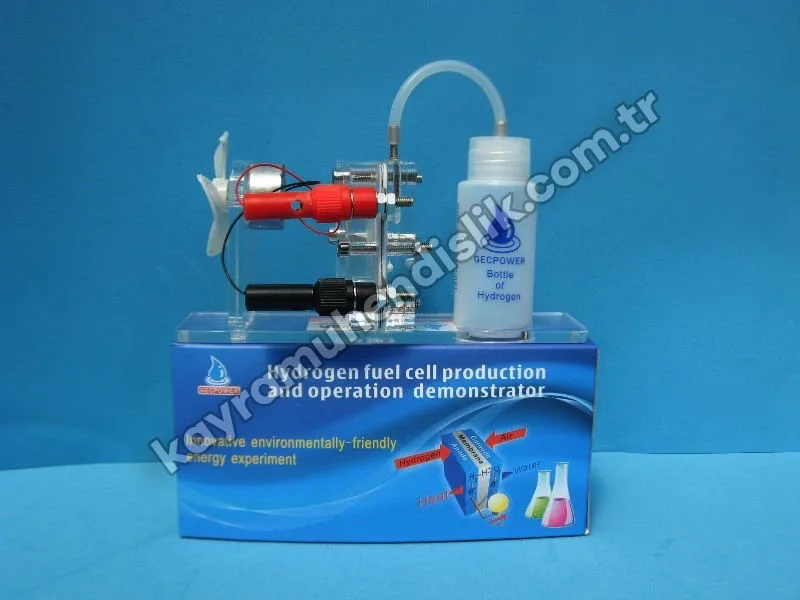
Hydrogen Fuel Cell Experiment KEP5020
In the Fuel Cell Experiment set, the operation of the fuel cell using hydrogen and the principles of this process can be studied.
Description
Conventional power generation systems first use a combustion reaction to convert the energy in the fuel into electricity. For combustion to be efficient, the fuel and oxidizer (oxygen) must mix completely. After that, a series of intermediate processes is needed until electrical energy is produced. Each intermediate process causes energy loss and therefore lowers efficiency.
In a fuel cell, however, the energy of the fuel can be converted directly into electrical energy. The fuel and oxidizer are in separate compartments and, unlike conventional systems, do not mix. They combine only through ion and electron transfer between these compartments.
A fuel cell converts the energy of the fuel directly into electrical energy through an electrochemical reaction. It produces electricity with externally supplied fuel (anode side) and oxidizer (cathode side), which react in an electrolyte/electrode unit. Generally, the reactants enter the cell while the reaction products leave it. Fuel cells can run indefinitely as long as the required flows of fuel and oxidizer are supplied. In this experiment set, the operation of the fuel cell using hydrogen and the principles of this process can be studied.
Delivery and Installation
Before shipment, our products are inspected and packed in special impact-resistant packaging, and are delivered safely to every province of Türkiye.
Installation: In laboratory and classroom projects, installation and commissioning after delivery are carried out by our expert team.
Training and support: User training and after-sales technical support are provided for experiment sets and simulators.