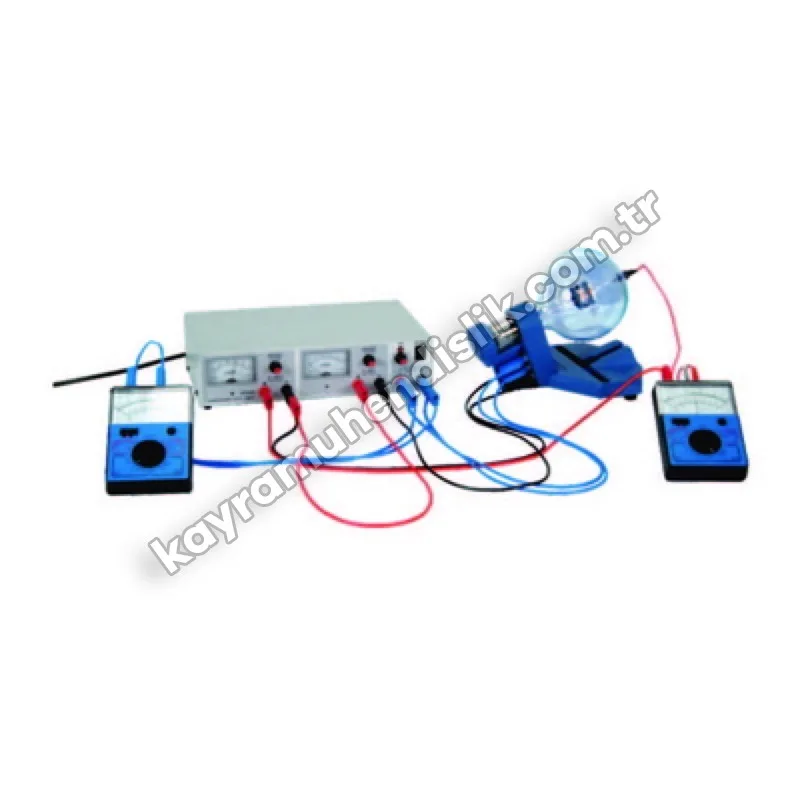
 Click to enlarge
Faraday Effect - KYR40600
Ask About This ProductDescription
PRODUCT DESCRIPTION;
Optically isotropic, transparent and non-magnetic materials become optically active in a magnetic
field. They rotate the plane of polarisation of linearly polarised light passing through them in the direction
of the magnetic field, because the clockwise and
anticlockwise polarised components of the light take different amounts of time to pass through.
This effect is known as the Faraday effect. In this experiment, the Faraday effect is measured for flint glass. This
special type of glass shows a high, characteristic optical dispersion. The dependence of the refractive index n on
frequency is given by Cauchy's formula.
BASIC PRINCIPLES;
Optically isotropic, transparent and non-magnetic materials
become optically active in a magnetic field. They rotate the plane
of polarisation of linearly polarised light passing through them in the direction of the magnetic field,
because the clockwise
and anticlockwise polarised components of the light take different
amounts of time to pass through. This effect is known as the Faraday effect.
The difference in the time taken by polarised light to pass can be described, using a simple
model, by the changes in frequency experienced by polarised light
in a magnetic field. For
clockwise polarised light, a small increase in the frequency f, called the Larmor frequency,
is observed.
(1) ,
e = 1.6021 x 10⁻¹⁹ As: charge of an electron
me = 9.1 x 10⁻³¹ kg: rest mass of an electron
The frequency of anticlockwise polarised light is reduced by the same
amount.
(2)
The different frequencies can be attributed to different refractive indices in the material. This
means that the propagation speed of the waves in the material is also
different.
This makes it possible to determine the direction of the plane of polarisation in optically active
materials as follows:
(3)
d: length of the sample,
: speed of light
Since the Larmor frequency fL is much smaller than f:
(4)
In addition, the rotation angle ϕ is proportional to the magnetic field B and to the length
d of the material through which the light passes:
(5)
The proportionality constant
(6)
is called the Verdet constant and depends on the dispersion, at frequency f, of the material
through which the light passes
In this experiment, measurements are made of the Faraday effect in flint glass
(F2). This special type of glass shows a high, characteristic optical dispersion.
The dependence of the refractive index n on frequency is given by Cauchy's formula.
(7)
where a = 1.62, b = 8920 nm²
To increase the accuracy of measurements for small rotation angles, this
experiment is set up so that, with a positive magnetic field B, the light polarisation and the analyser
filter make the transmitted light go completely dark at exactly 0°.
If the magnetic field is negative, -B, the analyser must be rotated
through the angle 2ϕ to block the light again.
Delivery and Installation
Before shipment, our products are inspected and packed in special impact-resistant packaging, and are delivered safely to every province of Türkiye.
Installation: In laboratory and classroom projects, installation and commissioning after delivery are carried out by our expert team.
Training and support: User training and after-sales technical support are provided for experiment sets and simulators.