 Click to enlarge
Atmospheric Pressure Plasma Torch - Plasma Jet Systems KED4301
Surface activation with our RF power supply
Description
Possible experiments:
- Atmospheric pressure torch experiments
- Torch experiments with gases: Ar, N, He, O2
- Torch current-voltage characteristics
- Torch plasma emission spectrometry studies
- Measuring electron temperature and electron density with Langmuir probes
- Effects of power and frequency on torch plasma light intensity
- Torch tip temperature measurements
- Surface activation and producing hydrophilic surfaces
- Sterilisation by surface activation
- Gas mixture experiments
- Torch plasma experiments
TECHNICAL INFORMATION
Power supply: 1 phase 1 neutral, 220 V-240 V, 50 Hz, 100 W-200 W
Power supply output: 0-18 kV adjustable DC / 5-20 kHz RF
Torch tube dimensions: D = 10 mm, L = 120 mm, 1 pneumatic inlet
Gas connection: pneumatic 8 mm, 2 inlet: 10 l argon, nitrogen, helium, oxygen, etc.
Light intensity measurements: photodiode, 200-800 nm / microammeter
Spectrometer measurements: emission spectrometer 200-800 nm
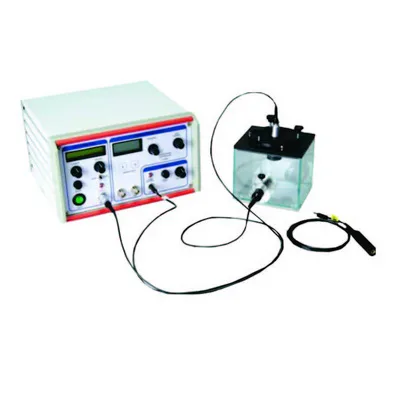
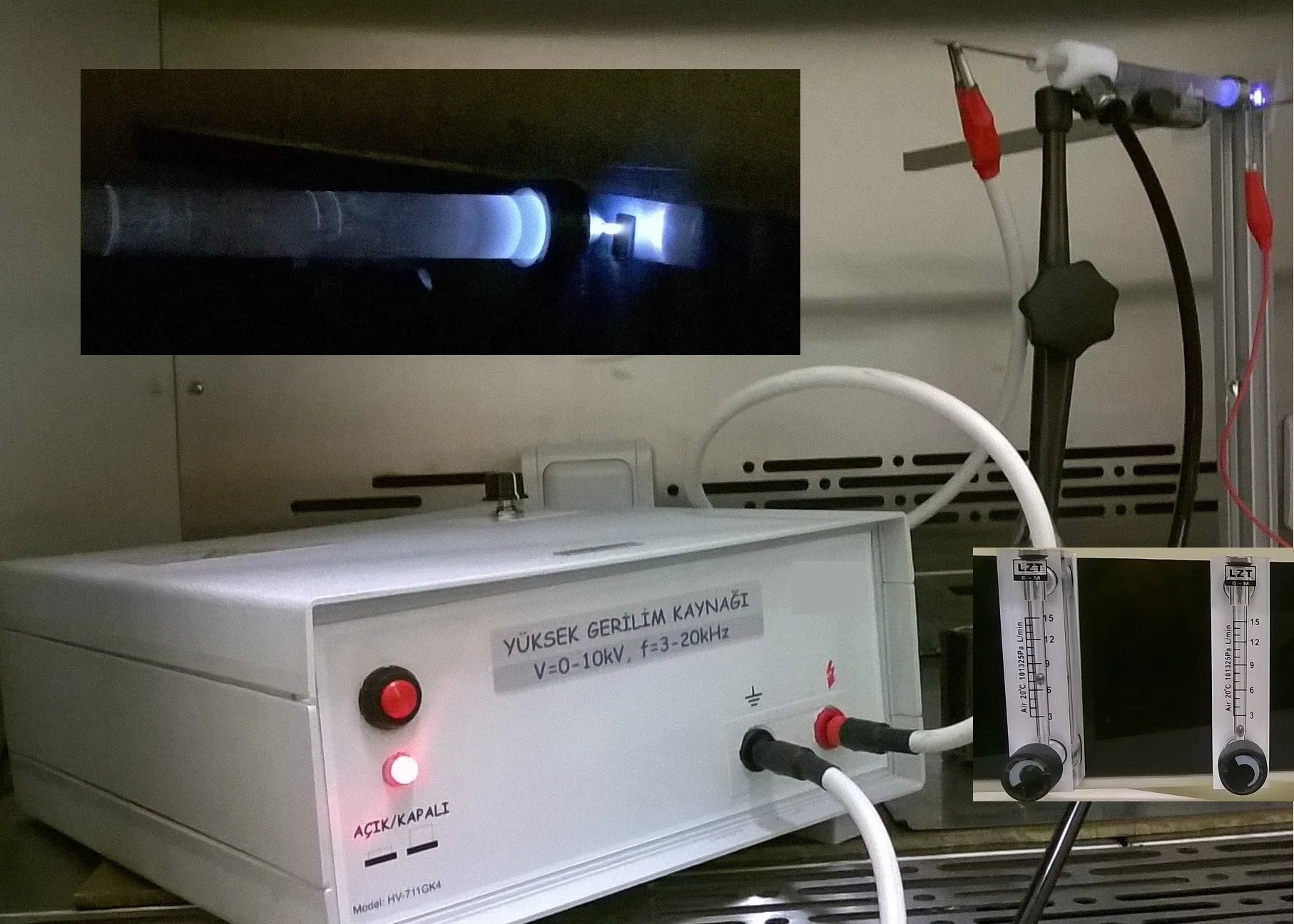
The plasma torch system can be used for surface activation before thin-film coating of any surface. Gas cylinders of 10 l (or larger) can be used in our system at any flow rate. The flow rates of two separate gases can be measured with flowmeters, and the gases mix in a mixer manifold before reaching the torch gas inlet. The torch head, placed in a quartz tube, is designed to produce a discharge 0.5-2 cm long. When this discharge plasma beam strikes targets (plastic, glass, metal surfaces), the surface energy increases and a hydrophilic property is obtained. Our torch's surface activation also makes it possible to eliminate micro-organisms (sterilisation). The system is used with an RF power supply (our own manufacture) whose output can be adjusted between 0-18 kV DC or AC voltages. As well as the voltage, the frequency can be adjusted between 1-30 kHz. Using this system, various high-level plasma experiments can be carried out. Torch plasma properties can be studied by varying them (gas mixtures, flow rates, gas types, power values, frequency, etc.). A Rogowski coil placed near the torch tip can be used to study plasma oscillations with an oscilloscope connection. There are 2 gas inlets and 2 flowmeters before the gas mixing manifold. If required, the number of gas inlets can be increased.
Delivery and Installation
Before shipment, our products are inspected and packed in special impact-resistant packaging, and are delivered safely to every province of Türkiye.
Installation: In laboratory and classroom projects, installation and commissioning after delivery are carried out by our expert team.
Training and support: User training and after-sales technical support are provided for experiment sets and simulators.