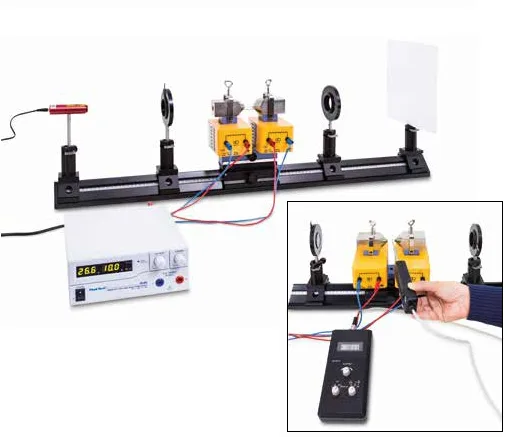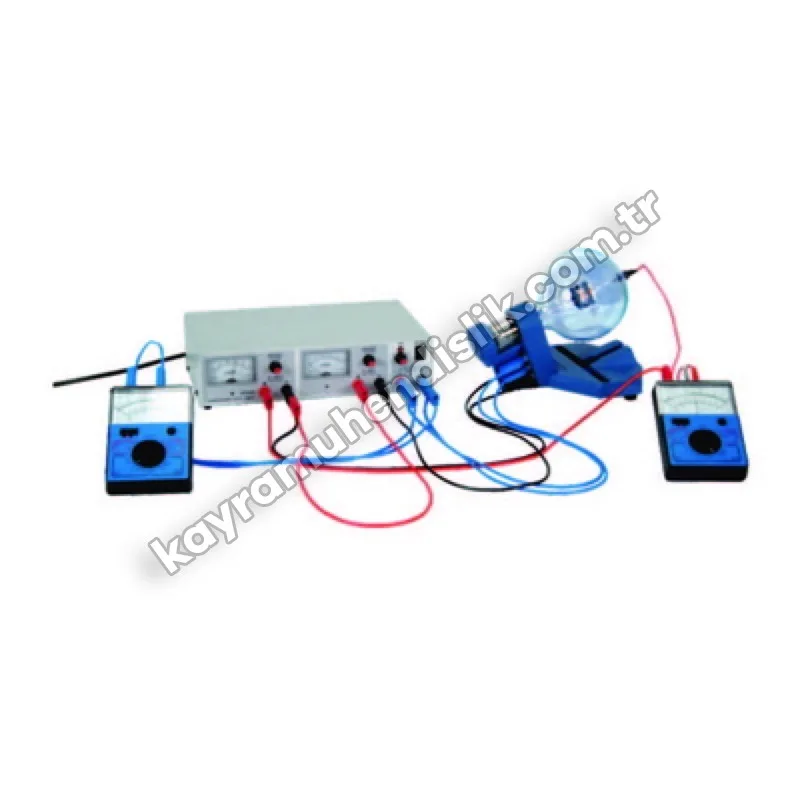
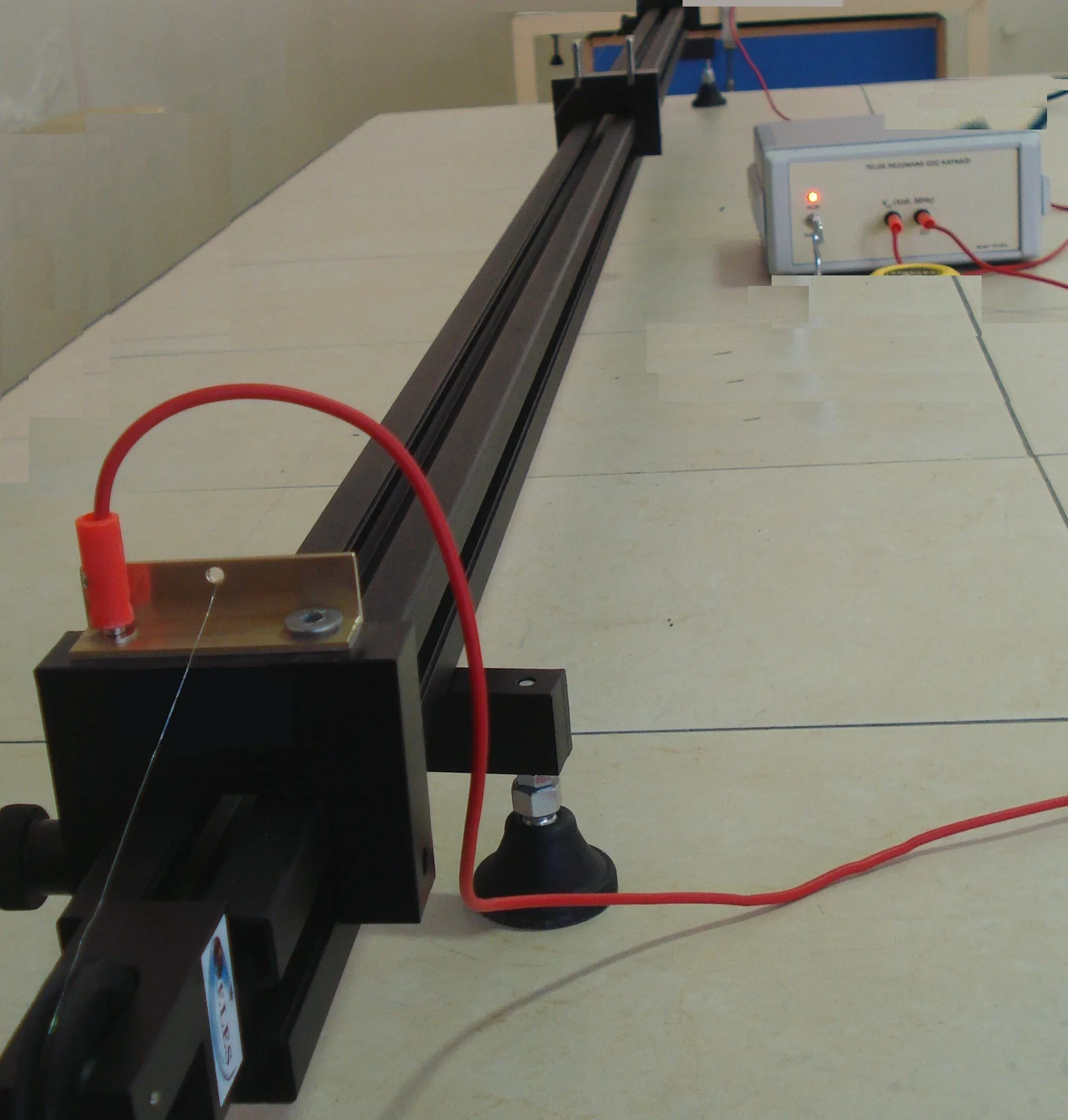
 Click to enlarge
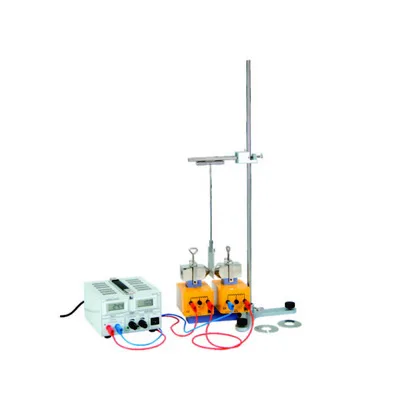
Current in Wire and Magnetic Field Resonance Experiment Set KED4101
Resonance experiments with an AC 50 Hz power supply
Description
Experiments that can be carried out:
- Studying resonance waves in a wire carrying alternating current and tensioned by a hanging mass
- Studying how the speed of sound waves in the wire depends on the tension and the mass per unit length of the wire
- Comparing the resonance frequency of the wire with the mains frequency
Product Features:
The speed of a wave in a wire fixed at both ends depends on the tension F and the mass per unit length of the wire (μ=m/L).
V = √F/μ
Because the wire is fixed at both ends, the standing waves in it are stationary at the ends, and these points are called nodes. The parts of the wave with maximum amplitude are called antinodes. With n the number of half-wavelengths, the length of the wire is given by L = n λ/2.
λ=2L/n
For example, in the figure below there are n=3 half-waves, so L=3λ/2 and λ=3/2L. If the speed of sound in the wire is V = λf, with f the frequency, and the tension comes from the weight (F = Mg), the frequency
f = n/2L√Mg/μ ρ πr2
is obtained. Since the wire is supplied from a mains-frequency power supply, this frequency should be about 50 Hz.
Delivery and Installation
Before shipment, our products are inspected and packed in special impact-resistant packaging, and are delivered safely to every province of Türkiye.
Installation: In laboratory and classroom projects, installation and commissioning after delivery are carried out by our expert team.
Training and support: User training and after-sales technical support are provided for experiment sets and simulators.