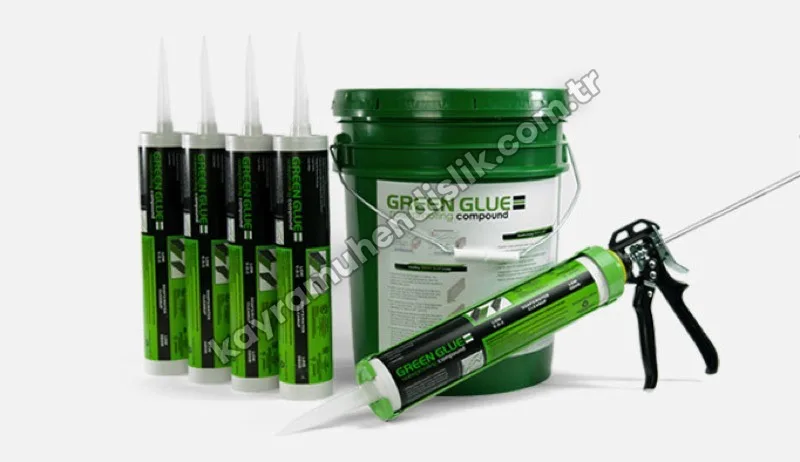
 Click to enlarge
KYR41996 - KYR GREEN GLUE
KYR41996 - KYR GREEN GLUE. Green Glue Compound is a visco-elastic material that can be applied in buildings under construction as well as in renovation projects. It provides sound insulation by absorbing, through its damping property, the vibrations caused by sound waves travelling between floors, walls and ceilings.
Description
Green Glue Compound is a visco-elastic material that can be applied in buildings under construction as well as in renovation projects. It provides sound insulation by absorbing, through its damping property, the vibrations caused by sound waves travelling between floors, walls and ceilings.
Applied between the layers of floor, ceiling and drywall systems, it greatly reduces sound transfer from one room to another. After application it keeps its density and does not harden or dry out as similar products do.
Green Glue Soundproofing Clips separate two sections of a wall so that each vibrates independently, increasing sound insulation. Used with Green Glue Compound, they provide 95% more sound insulation than walls built by traditional methods. As they are designed to insulate low-frequency sound waves, walls reinforced with these clips are used to insulate bass sounds such as those of home cinema and home entertainment systems.
Green Glue Noiseproofing Sealant is used to seal cracks in walls, ceilings and floors that could let sound through, preventing sound transmission. It is easily applied with a caulking gun. For maximum performance, application to all corners and joints is recommended.
Green Glue Joist Tape is used against footstep noise and squeaks. Green Glue joist tape is applied to the joist or floor with the adhesive side down. As well as sound insulation, its low thermal conductivity improves energy efficiency and provides thermal insulation. It is easily applied to uneven surfaces and does not break. It is unaffected by weak acids, alkalis and mould.
Applications
- Sound passing through interior walls between rooms
- Sound transmitted indirectly through shared joists
- Sound spreading from ventilation gaps and heating/cooling ducts
- Windows and doors through which outside noise enters
- Ceilings, to insulate footstep noise from the floor above
Delivery and Installation
Before shipment, our products are inspected and packed in special impact-resistant packaging, and are delivered safely to every province of Türkiye.
Installation: In laboratory and classroom projects, installation and commissioning after delivery are carried out by our expert team.
Training and support: User training and after-sales technical support are provided for experiment sets and simulators.