 Click to enlarge
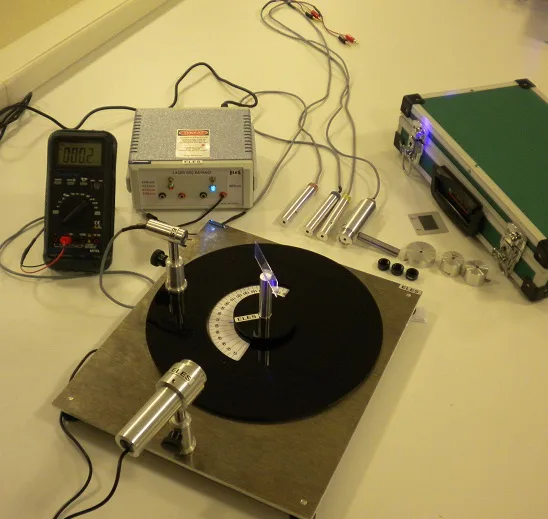
Brewster's Angle Experiment Set KED4213
Determining Brewster's angle with a single laser or with lasers of 5 different wavelengths
Description
Experiments that can be carried out:
- Photodiode measurements
- Brewster angle experiments,
- Refractive index measurement experiments
Standard Materials
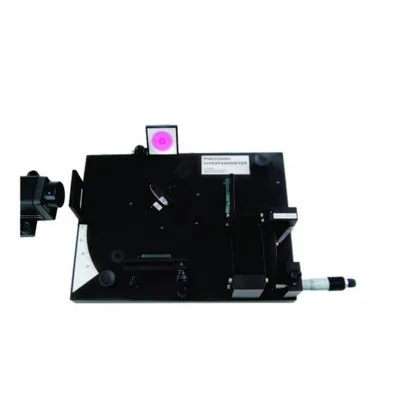
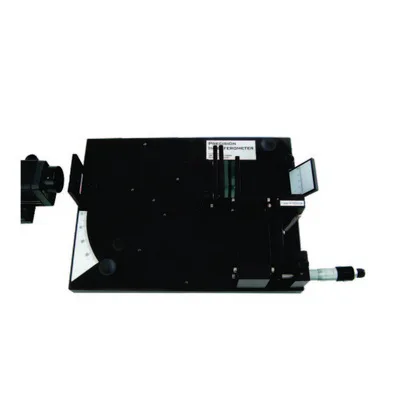
approx. 100 mW single red or 5 (violet, blue, green, red, infrared) diode lasers, 1 rotary table, 1 photodiode, 1 microammeter, 1 laser power supply of our own manufacture, interchangeable glass holder, 1 polariser, 1 graduated scale plate, connecting cables.
Additional materials
The experiment is carried out with a 608 nm red laser. If required, a version with 405, 445, 532, 660 and 808 nm lasers can also be supplied.
Notes
When an electromagnetic wave passes through a medium, the atoms or molecules of the matter interact with the E field of the wave, and the E field is either absorbed or transmitted. This property is a technique used to obtain polarised light. E. H. Land (1938) discovered a material that polarises light by selective absorption with oriented molecules, and named it polaroid (polariser) ; he made it in thin layers of long-chain hydrocarbons. The direction perpendicular to the molecular chain is called the transmission axis. In a good polariser, all light whose E is parallel to the transmission axis passes, and all light whose E is perpendicular to it is absorbed. When incoming light passes through a polariser with a vertical transmission axis, it becomes vertically polarised. If the electric field is in the plane of motion, S polarisation results; if it is perpendicular to this plane, P polarisation results. Accordingly, for P polarisation the reflection coefficient becomes zero at approximately 57 degrees. Although ideally zero, in real life this value falls only to a certain minimum, because of losses in the media and because polarisers are not ideal or do not polarise equally at every wavelength. The angle at which this occurs is called Brewster's angle. At this angle θ1+ θ1=90°, or the angle of incidence equals Brewster's angle: θ1= θbr=arctan(n2/n1). Using this equation, with n1 the refractive index of air, the refractive index n2 can be determined. Since the refractive index of a material that transmits light depends on wavelength, Brewster's angle also depends on wavelength.
Delivery and Installation
Before shipment, our products are inspected and packed in special impact-resistant packaging, and are delivered safely to every province of Türkiye.
Installation: In laboratory and classroom projects, installation and commissioning after delivery are carried out by our expert team.
Training and support: User training and after-sales technical support are provided for experiment sets and simulators.